Fleet & Vehicle Wraps — Tempe / Phoenix AZ — 2026 Guide
What the film is bonding to, what the manufacturers exclude, and what the Arizona sun does to a marginal panel
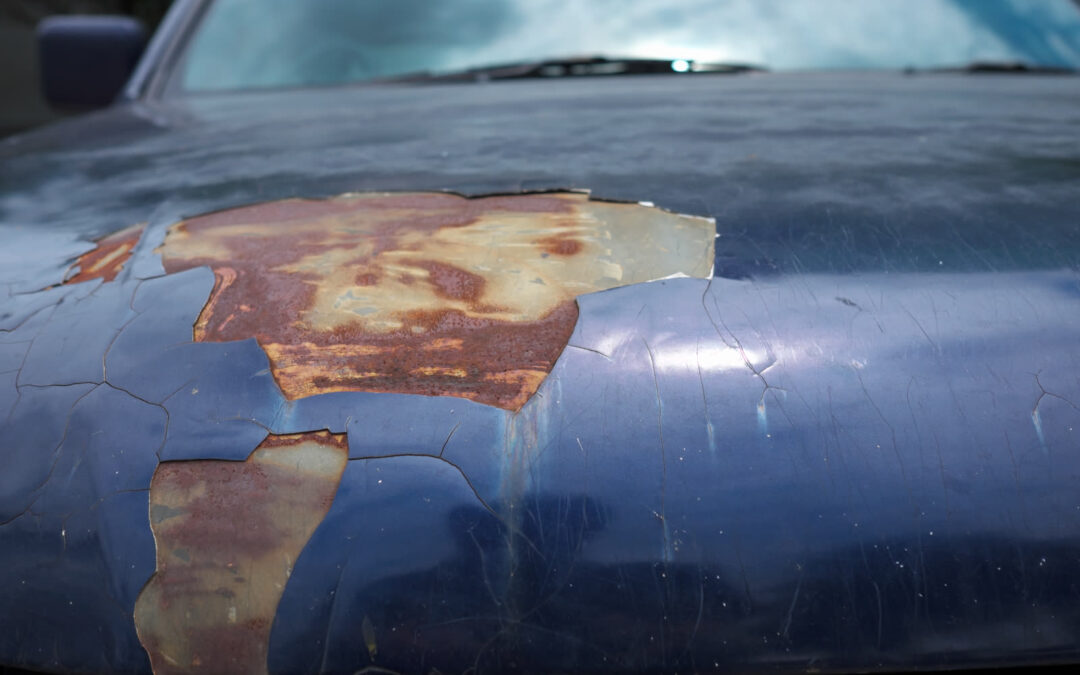
Can you wrap a car with peeling clear coat? Not safely. Vinyl bonds to the topmost layer of the finish, so failing clear coat, an uncured repaint, or body filler can let the film lift — and can pull paint off at removal. 3M and Avery Dennison both exclude non-OEM paint from their paint-damage warranties. Ask ProVinyl to evaluate the panels before the project is quoted.
Updated September 2026 · Tempe, AZ — serving the Valley since 2014
What this comes down to:
- Vinyl bonds to the top layer, not the metal. If that layer is loose, the bond is only as good as the paint holding it.
- 3M’s MCS warranty is explicit: “Non-OEM painted vehicles: No warranty for paint damage.”
- Avery’s ICS guarantee lists non-OEM painted vehicles, paint that is not thoroughly cured, and substrates with poor paint-to-paint bond as applications the product is not designed or recommended for.
- Film telegraphs. Cast wrap film runs roughly 2.0 to 2.5 mil. It does not hide a defect — it outlines it.
- Removal is the real test. 3M’s own bulletin warns that paint or filler may be pulled off during removal, depending on the condition of what is underneath.
- Arizona is the manufacturers’ harshest zone. Avery’s Instructional Bulletin 1.30 (Revision 10, dated March 8, 2024) places Arizona in Zone 3 and cuts warranty length there by 60%. A non-vertical surface adds a further 20% on top of that, and horizontal applications — the hood, the roof, the trunk lid — are “not warranted and do not have any expectations of warranty” unless the individual product data sheet says otherwise.
Every wrap shop in the Valley gets this call. A six-year-old service van, a hood and roof going chalky, a couple of doors resprayed after a parking-lot incident, and a fleet manager who would rather spend money on graphics than on paint. The question is always the same: can we just wrap over it?
Vinyl may physically adhere to some compromised surfaces. That does not make the installation low-risk. A wrap over a failing surface is a risk transfer, not a repair — and the risk tends to land twice: once when the film lifts early, and again on removal day when the film comes off with paint attached.
Here is what the manufacturers actually publish, and how to read your own panels before you spend anything.
Can You Wrap a Car With Peeling Clear Coat? What the Film Is Actually Sticking To
A wrap does not grip the steel or aluminum of the body. Its pressure-sensitive adhesive bonds to the highest layer of the vehicle’s coating system — normally the factory clear coat. That single fact drives everything else on this page. If the top layer is failing, the film is bonded to something that is already letting go.
The prep sequence tells you the answer before the film comes off the roll
Both major manufacturers publish strict surface-preparation sequences, and reading them is the fastest way to understand why a compromised panel disqualifies itself.
3M’s instruction bulletin for general application calls for a general cleaning first — a liquid dishwashing detergent solution, roughly one ounce of synthetic detergent per gallon of lukewarm water, to remove environmental fallout — followed by a solvent wipe with isopropyl alcohol to strip remaining oils. Avery Dennison’s instructional bulletins require that the substrate be entirely free of dirt, grime, grease, oil, wax, polish, copolymer, and solvent residue before application, and specify cleaners such as methylated spirits, isopropyl alcohol, Prepsol, or Avery’s own surface cleaner.
Now apply that to a chalking hood. 3M warns against finish paints that tend to chalk and notes that chalked paint on weathered surfaces must be removed mechanically before a wrap is attempted. In other words: the prep step that is supposed to make the surface ready is the step that peels a failing surface further. That is not a technician being careless. That is the material telling you the truth about the panel.
Telegraphing: a wrap is not a cover-up
The most expensive misconception in this category is that vinyl is a cosmetic bandage for hail dimples, deep scratches, or lifting clear coat.
Cosmetic wrap films are thin — roughly 2.0 to 2.5 mil for premium cast film, and up to about 4.7 mil for heavier textured finishes. Because they are engineered to conform intimately to compound curves, they follow the topography underneath them. That behavior has a name in the trade: telegraphing. 3M’s own Wrap Film Series 2080 FAQ acknowledges it directly, noting that rust, bubbling, scratches, dents, pitting, and orange peel will be visible through the film, and that light pearl whites can show subtle telegraphing of substrate imperfections.
So the stepped edge where clear coat has lifted does not disappear under vinyl. It reads through as a visible line — on a fleet vehicle, at every stoplight, under your logo.
Repaints and the cure window
A repaint is a different problem from a failing clear coat, and it has a clean technical answer.
Fresh paint outgasses — solvents escape the film as it hardens. Wrap it before that finishes and the trapped solvents form bubbles under the vinyl and attack the adhesive. The manufacturers publish cure guidance accordingly:
- Air-drying and car-repair paints: Avery advises allowing the paint to dwell at near room temperature for at least one week before film application.
- Latex systems: 3M specifies a minimum of one week.
- Two-part urethanes: 3M notes these must be thoroughly cured, and that curing generally requires ambient temperatures above 70°F (21°C).
There is one genuinely useful exception for fleets working against a deadline: baked paint. Avery’s instructional bulletin states that on most baked paints, films can be applied immediately after cooling. So a panel force-cured in a professional spray booth generally avoids the week-long wait — though “most” is Avery’s word, not ours, and the specific paint system should be confirmed rather than assumed.
Note what that exception does and does not do. It removes the cure delay. It does not convert an aftermarket respray into OEM paint for warranty purposes — see the next section.
The application temperature window matters here
3M’s Product Bulletin for Wrap Film Series 2080 gives a minimum application temperature of 60°F (16°C) and a maximum of 90°F (32°C). Avery similarly specifies a minimum of 60°F. Below the minimum the adhesive cannot bond adequately and the film becomes brittle; above the maximum the film gets aggressive and loses its repositionability.
In Phoenix, that is not an academic footnote. It is the reason a real shop wraps in a climate-controlled bay rather than in a lot in July — and it is one more variable that a marginal surface cannot afford to have working against it.
Non-OEM Paint and the Warranty Line: What 3M’s MCS and Avery’s ICS Exclude
This is the part nobody puts in an ad, and it is the part that decides who pays when something goes wrong.
Manufacturer warranties are limited legal agreements covering specified manufacturing defects. They are not insurance on your paint. And both major manufacturers draw the same hard line at factory paint.
3M’s MCS warranty documentation states it in five words: “Non-OEM painted vehicles: No warranty for paint damage.”
Avery Dennison’s ICS Performance Guarantee is parallel and equally direct. Avery states that the product is “not designed or recommended” for non-OEM painted vehicles, for paint that is not thoroughly cured or dried, or for painted substrates with poor paint-to-substrate, or paint-to-paint bond. Avery further notes that it does not warrant graphic removal from paint with poor adhesion or existing graphics.
Read that last clause twice if you run a fleet. It means the removal risk is explicitly outside the guarantee on exactly the surfaces where removal risk is highest.
What this means panel by panel
Warranty exclusions are not vehicle-wide abstractions. They attach to what is actually under the film.
If one door on a delivery van was resprayed after a collision, that door carries no manufacturer warranty against paint damage once the van is wrapped. The exclusion follows the repaint. Coverage on the remaining OEM-painted panels is not automatic either — it stays subject to the manufacturer’s full terms: eligible film and substrate, matched components, installation credentials, exposure zone, panel orientation, and maintenance.
That is a manageable fact, not a disqualifier, as long as everyone knows it before the film goes on and it is written down.
The other exclusions fleet buyers should know
- Abrasion and loss of gloss are not covered. Avery’s Supreme Wrapping Film product data sheet says so verbatim: “Abrasion and Loss of Gloss are not covered by any Avery Dennison® Warranty. These changes are considered normal wear and tear.”
- Rock and road-debris damage is excluded by both manufacturers, as is mechanical and chemical abuse — harsh chemicals, fuel spills, improper pressure washing.
- Wrapping over a previous wrap or over untreated adhesive residue is likewise excluded from Avery’s warranties.
Matched components, and who installs it
The most comprehensive warranty tiers are matched-component systems. The finished graphic is warranted only when the manufacturer’s base film, that brand’s corresponding overlaminate, and approved inks and printers are used together. 3M’s performance warranty covers combinations of 3M graphics products used with 3M-approved OEM-branded inks; Avery runs the parallel ICS Performance Guarantee for compatible films, inks, and clear coats, with its highest tier additionally requiring credentialed specialist converters and installers.
This is why “we can source that cheaper” is often a warranty conversation in disguise. Mixing brands across the film, laminate, and ink stack can put the finished graphic outside the matched-component coverage entirely.
And no — a wrap is not paint protection film
Color-change vinyl and PPF are different products built for different purposes. PPF is roughly 8 mil elastomeric TPU, engineered to absorb impact from rocks and road debris. Wrap film is roughly 2 to 3.5 mil cosmetic PVC vinyl with negligible impact resistance. Anyone selling you a wrap as paint protection is describing a product they are not installing.
Durability Is Not Warranty — and Arizona Is Zone 3
Two words get used interchangeably in this industry and they mean completely different things. Getting them straight is the single most useful thing a Valley fleet buyer can do.
- Durability is the manufacturer’s non-guaranteed estimate of how long a film should perform satisfactorily — published for vertical exposure, by climate zone, assuming proper storage, installation, and maintenance. Avery defines vertical as the face of the graphic being within about ±10° of vertical.
- Warranty is a limited legal agreement covering specified manufacturing defects for a set term, tied to those same zones and exposure angles. For Avery’s Supreme Wrapping Film the two are explicitly linked: “The term of Avery Dennison’s warranty is equal to the product’s durability.”
The baseline numbers you see advertised are Zone 1 numbers
Published figures describe idealized environments. 3M rates Wrap Film Series 2080 at up to about eight years on vertical applications in an ideal climate. Avery publishes Zone 1 vertical durability for certain Supreme Wrapping Film colors in the ten-to-twelve-year range.
Neither of those numbers describes a vehicle in Phoenix.
Arizona sits in Zone 3 — the US Desert Southwest, the harshest zone in both manufacturers’ systems, and the reductions are steep. Avery’s Instructional Bulletin 1.30, “Warranty of Avery Dennison Films,” Revision 10, dated March 8, 2024, lists Arizona in Zone 3 and states that materials used in Zone 3 regions “will have a 60% reduction in warranty length.”
Exposure angle is then a separate and additional reduction, not part of that 60%. Avery defines a non-vertical application as film on a surface 10° to 45° from vertical, and warrants it 20% less than the published vertical figure. Where a product is both non-vertical and in Zone 2 or Zone 3, the bulletin instructs that the two reductions be summed — so a non-vertical panel in Arizona carries the 60% zone reduction plus the 20% orientation reduction. 3M likewise defines Zone 3 as including the Desert Southwest and notes that non-vertical applications see a significant decrease in durability.
Horizontal panels are not on that percentage scale at all. Bulletin 1.30 gives them their own section, and the language is about as blunt as a manufacturer ever gets: “Unless otherwise specified in the individual product data sheet, horizontal applications are not warranted and do not have any expectations of warranty.” A hood, a roof, and a trunk lid are horizontal. Confirm the individual product data sheet for the exact film, color, and finish you are buying before relying on any figure for those panels.
Practical handling: when you are quoting, ask for the zone-adjusted figure from the current bulletin for the specific film and color you are buying, separated into vertical and horizontal. A shop that can produce that is reading the manufacturer’s documentation. A shop that answers with a single flat number for the whole vehicle is not.
That is also why you will never see a flat lifespan on this site. “Wraps last four to six years in Phoenix” ignores panel orientation, color, garaging, and care — and it sets an expectation the manufacturer never made.
Removal Day: When Film Comes Off Clean, and When It Takes the Paint With It
The true cost of wrapping a marginal surface is almost never paid at installation. It is paid when the film comes off.
The physics are simple and unforgiving. The adhesive bond between the vinyl and the topcoat can exceed the bond between that topcoat and what is under it. When that happens, the film wins.
How removal is supposed to go
Clean removal means breaking the adhesive bond without shocking the substrate. 3M’s removal bulletin calls for heat to soften the adhesive — a specified graphic temperature range of 160°F to 200°F (72°C to 93°C) with a heat gun or steamer — and a high pull-off angle of roughly 120 degrees. Avery advises starting at a corner and pulling toward yourself at about 90 degrees. Residue is addressed with approved mild citrus-based cleaners or isopropyl alcohol.
Note what is not promised. 3M’s bulletin states it plainly and repeatedly: “3M makes no claims as to the ease or speed of removal.” If you are budgeting a de-identification window before a lease return, budget it against that sentence.
What the manufacturers say about compromised paint
They are blunt.
3M warns that “depending on the condition of the underlying materials, paint or filler may be pulled-off during the removal process,” and that “removing graphics from substrate that were not in good condition at the time of application may result in substrate damage.”
Avery’s clean-removability guarantee — defined as leaving less than 30% adhesive residue — is voided on surfaces with poor paint-to-substrate adhesion, improperly cured paint, or oxidized or chalked substrates. On those surfaces, Avery states it cannot guarantee damage-free removal.
So the honest sequence on a failing panel is: the wrap goes on, it looks acceptable for a while, and then it comes off carrying the clear coat that was already letting go. The wrap did not cause the failure. It finished it, and it moved the bill from a repaint you were considering to a repaint you now have no choice about.
Leaving it on too long is its own failure mode
There is a second removal risk that has nothing to do with the paint underneath, and it hits hardest in this climate.
Past a film’s regional durability window, UV exposure drives plasticizer migration out of the PVC. The film loses flexibility, embrittles, and effectively bakes onto the clear coat. Instead of peeling off in sheets, it tears into small brittle chips while the adhesive hardens and etches into the surface. 3M notes that ease and rate of removal depend heavily on whether the film is removed within the period specified in the product bulletin.
For a leased fleet, that is a direct financial exposure: a grueling de-identification, labor hours nobody quoted, and potential penalties from the leasing company for damaged OEM paint. Plan the removal date when you plan the install — especially in Arizona, where the window is shorter than the advertised baseline.
Cast vs. Calendered on a Marginal Surface: Which Film Pulls Harder
Film construction changes how aggressively the material tugs at weak paint, and the difference is larger in this climate than anywhere else.
Cast film is liquid PVC poured in a tension-free state and cured flat. It has essentially no mechanical memory, holds a stretched shape, and conforms to compound curves and deep recesses. It is the appropriate choice for a Phoenix color-change or a long-run fleet wrap. Its trade-off is thickness: at roughly 2.0 to 2.5 mil, it telegraphs maximally.
Calendered film is a solid PVC mass forced through heated rollers. It carries high internal stress and remembers its original flat shape. It runs thicker — roughly 3.0 to 4.0 mil — and is limited to flat panels and simple curves. 3M notes that calendered films are not a good choice for complex curves, deep channels, severe contours, or corrugations.
Here is why that matters on a marginal panel. Under Arizona surface temperatures, the stored stress in a stretched calendered film releases and the material tries to shrink back toward flat. On a healthy panel that produces edge lifting and tenting in recesses. On a panel with failing clear coat, that shrink-back becomes a constant, aggressive pull against paint that is already losing its grip — accelerating exactly the delamination you were trying to hide.
If a quote for a compound-curved vehicle is notably cheap, ask which film it is written on.
The Arizona Multiplier: Why a Marginal Surface Fails Here First
Every weakness described above gets worse in the Sonoran Desert, and it is worth being precise about why.
Vertical versus horizontal is the whole story
Manufacturers separate these deliberately. Avery defines vertical exposure as within about ±10° of vertical and horizontal exposure as between 45° and 90° from vertical — the hood, the roof, the trunk. Vertical panels take sunlight at a glancing angle. Horizontal panels take it close to perpendicular, absorb the maximum UV and heat load, and collect settling atmospheric dust and pollutants that sit and bake.
That is precisely why both manufacturers publish durability for vertical exposure and cut it as the panel tips over — and why Bulletin 1.30 stacks a 20% orientation reduction on top of Arizona’s 60% zone reduction for non-vertical surfaces, then leaves horizontal applications outside warranty coverage altogether unless the product data sheet says otherwise.
The practical consequence for a fleet: the roof and hood of a Valley van are on a different clock than its doors. Any conversation about wrap life that does not separate them is not a real conversation.
Color and finish
Darker pigments absorb more infrared and run hotter, which raises thermal stress. Metallic, pearl, and matte finishes lack a protective clear over-laminate, which leaves them more UV-sensitive and more prone to staining from hard water and chemicals — a real issue in a market with the water we have.
Care that actually conditions the coverage
Improper care voids manufacturer coverage, and proper care is the honest lever for real-world life here:
- Hand-wash or touchless only. Automatic brush washes cause micro-scratching and edge lifting and can void coverage.
- Wet, non-abrasive, pH-neutral cleaners — roughly pH 3 to 11 — and no strong solvents.
- Pressure washing has published limits. 3M specifies keeping water pressure below 2,000 psi and water temperature below 180°F, using a 40-degree wide-angle nozzle held at least a foot from the graphic and sprayed perpendicular to it. Avery’s bulletin is tighter: a maximum of 1,200 psi, water temperature no higher than 158°F, a minimum nozzle distance of 12 inches, and the nozzle held perpendicular within about ±10°. If your fleet runs through a pressure-wash bay, hand these numbers to whoever operates it.
- No petroleum-based waxes. Matte and satin finishes should never be waxed or polished — it causes irreversible gloss shift.
- Rinse dust before it dries. Fine desert silica is abrasive under a mitt or a jet.
- Shade or garage where you can, specifically to reduce the horizontal-panel load.
Printed fleet graphics need their laminate
One fleet-specific point that is not optional here. Printed fleet graphics use printable cast film, and printed ink is vulnerable to UV the moment it is on the vehicle. A matching cast overlaminate is required — for UV protection, for abrasion resistance, and to qualify for matched-component coverage at all. Skipping the specified matching cast overlaminate leaves the printed ink far more vulnerable to UV degradation and can disqualify the graphic from matched-component warranty coverage — and Zone 3 is where that exposure is highest.
If the Panel Fails the Test: Three Honest Options
When a vehicle shows up with lifting clear coat, deep scratches, or unverified fresh bodywork, there is no risk-free path. There are three defensible ones.
1. Refinish and cure, then wrap. Strip, prime, and repaint the compromised panels with a quality coating system, then observe the cure period — at least one week at near room temperature for air-drying and automotive-repair paints per Avery, potentially longer depending on the paint system and the paint manufacturer’s own instructions, or a thorough heat cure for two-part urethanes. Avery states that on most baked paints film can be applied after the paint has cooled, so a booth-baked panel generally avoids the wait — but confirm it for the specific system rather than assuming it. This is the most complete answer, and it restores a surface the film can actually bond to. Understand that the repainted panels are still non-OEM for warranty purposes.
2. Limit the wrap to the sound panels. If the failure is on the roof and hood, wrap the vertical panels — which are the panels with better durability coverage anyway — and use cut graphics, decals, and lettering blended into healthy OEM paint elsewhere. For a fleet, this often delivers most of the brand impact while avoiding the compromised areas entirely. Our vinyl graphics and partial wraps work exactly this way.
3. Wrap it anyway — with the trade-offs in writing. A shop can install over degraded paint if the client acknowledges what they are accepting: the film will telegraph the defects, the manufacturer’s warranty against paint damage is void on those panels, and on removal the film will very likely take the remaining loose paint with it. That can be a rational business decision on a vehicle near the end of its service life. It is only a bad one when nobody said it out loud first.
What none of these options is: a wrap sold as a repair.
Frequently Asked Questions
Can you wrap a car with peeling clear coat? The film may physically adhere, but peeling clear coat makes both adhesion and removal unsafe, and manufacturer paint-damage and clean-removal coverage is excluded or limited on non-OEM, improperly cured, or compromised paint. The adhesive bonds to the top layer of the finish, so a lifting clear coat gives the film something that is already letting go. The defect will telegraph through the vinyl, and on removal the film is likely to pull the failing clear coat with it. The honest options are to refinish the panel first, wrap only the sound panels, or proceed with the trade-offs documented in writing.
Will a wrap hide bad paint, hail dents, or deep scratches? No. Premium cast wrap film is roughly 2.0 to 2.5 mil thick and is engineered to conform to the surface underneath it. 3M’s own 2080 FAQ notes that rust, bubbling, scratches, dents, pitting, and orange peel remain visible through the film. A wrap outlines a defect; it does not conceal one.
Can you wrap a repainted vehicle? Yes, with two conditions. First, the paint must be fully cured — Avery advises at least a week at near room temperature for air-drying and car-repair paints, 3M specifies a minimum of a week for latex systems and thorough curing for two-part urethanes, and Avery states that on most baked paints film can be applied after the paint has cooled. Second, understand that a repaint is non-OEM: 3M’s MCS documentation states “Non-OEM painted vehicles: No warranty for paint damage,” and Avery lists non-OEM painted vehicles among the applications its product is not designed or recommended for.
How long will a wrap last in Phoenix? No responsible shop can give you a single number, and we will not. What we can give you is the manufacturer’s published framework: 3M rates Series 2080 at up to about eight years on vertical applications in an ideal climate, and Avery publishes Zone 1 vertical durability for certain Supreme Wrapping Film colors in the ten-to-twelve-year range. Arizona is Zone 3, the harshest zone. Avery’s Instructional Bulletin 1.30 (Revision 10, March 8, 2024) cuts warranty length in Zone 3 by 60%, applies a further 20% reduction to non-vertical surfaces on top of that, and states that horizontal applications are not warranted at all unless the individual product data sheet says otherwise. Ask for the zone-adjusted figure from the current bulletin for your specific film, color, and finish, split by exposure angle.
Does the manufacturer warranty cover my paint if the wrap damages it? Not over non-OEM paint. 3M excludes paint damage on non-OEM painted vehicles outright. Avery does not warrant graphic removal from paint with poor adhesion, and its clean-removability guarantee is voided on surfaces with poor paint-to-substrate adhesion, improperly cured paint, or oxidized or chalked substrates. On sound OEM paint with a film removed within its window, clean removal is the normal outcome.
Is it cheaper to wrap over failing paint than to repaint first? It looks cheaper at the quote and frequently is not by the end. The wrap telegraphs the defect, the warranty against paint damage is void on those panels, real-world life is shorter because the bond is compromised, and removal is likely to strip the remaining paint — turning an optional repaint into a mandatory one. For a leased vehicle, add the possibility of a damage charge at return.
Does a wrap protect my paint the way PPF does? No — different products for different jobs. Paint protection film is roughly 8 mil elastomeric TPU designed to absorb rock and debris impact. Wrap film is roughly 2 to 3.5 mil cosmetic PVC vinyl with negligible impact resistance. If impact protection is the goal, that is a separate conversation about a separate product.
How do I keep a fleet wrap from failing early in the desert? Specify cast film with a matching cast overlaminate on printed graphics, install on sound OEM paint, wash by hand or touchless with pH-neutral cleaners, respect the published pressure-washing limits, skip petroleum waxes entirely, rinse dust before it dries, shade the vehicles where you can, and plan removal before the film passes its window. None of that guarantees a duration — it maximizes what the material can actually deliver here.
Ready to Find Out What Your Panels Will Actually Take?
The best thing a wrap shop can do for a fleet is tell the truth about the surface before anyone spends money. Sometimes that means a wrap. Sometimes it means graphics on the doors and nothing on the roof. Sometimes it means fixing two panels first.
ProVinyl has been wrapping vehicles in Tempe and across the Valley since 2014, and we design, print, and install in house — no outsourced printing, and no handoffs between companies.
Get a free consultation and quote: call (480) 410-9727 or contact us here to talk through your vehicle’s paint condition, your film options, and the manufacturer terms that would apply. If you are running a fleet, start with our printed commercial and fleet wraps; if this is a personal vehicle, our car wraps page is the place to begin.
Recent Comments