Fleet Wraps · Tempe & Phoenix, AZ · 2026 Guide
Fleet wrap cost in Phoenix is set by your fleet: how many vehicles and which kinds, how much of each you cover, the film and overlaminate, the design work, installation around your schedule and the paint underneath. ProVinyl Solutions designs, prints and installs in Tempe, and fleet quotes are free.
Updated October 2026 · Tempe, AZ — serving the Valley since 2014
The short version:
- Vehicles come first. Vans, box trucks and pickups take different amounts of film and shop time.
- Coverage is your main lever. Less coverage means less film and installation time.
- A printed wrap is a system. The film maker’s coverage depends on an approved film, overlaminate, ink and printer combination, so ask who holds and extends that warranty.
- Arizona gets the shortest terms. Both makers put it in Zone 3, where hoods and roofs get the least.
For the service itself, see our fleet wraps page.
Fleet Wrap Cost in Phoenix Starts With Your Vehicle List
Size and shape both drive film and shop time.
- Cargo vans have big sides plus curves, recesses and handles.
- Box trucks and trailers have flat sides, often with rivets and corrugations. 3M calls its IJ180Cv3 print film “optimal for trailer & box truck graphics,” but its warranty bulletin excludes lifting or tenting around rivets: certain films “may tent around or lift near rivets.”
- Pickups and cars take less film but still have curves and trim to work around.
How Much of Each Vehicle? Full, Three-Quarter, Partial or Lettering
Coverage is the driver you control most, and it can vary by vehicle.
- Full wrap: film over the painted body; the most film and shop time.
- Three-quarter wrap: most of the body, with part of it, often the front end, left in factory paint.
- Partial wrap: selected panels, such as the sides or rear doors, using the vehicle’s own color in the design.
- Lettering and decals: cut vinyl for a logo, phone number, website or USDOT number; the least film and time.
Which Film and Overlaminate? Cast vs. Calendered, and Printed Systems
Cast film generally costs more than calendered film. Avery Dennison sells its intermediate calendered digital films as “medium term durability films for flat applications” and its cast SuperCast films for “substrates with curves and recesses.” Calendered film tends to shrink back in heat, so for a curved van body meant to run for years in Arizona, cast film is the appropriate choice.
A printed design goes onto a printable cast film, such as 3M’s IJ180 series or Avery’s MPI 1105 (made “for use in fleet marking and vehicle wrap”), under a clear overlaminate. Coverage is conditional on an approved system: 3M’s Performance and MCS warranties need the film, overlaminate, ink and printer listed in its warranty matrices (“The substitution of non-approved products invalidates warranty coverage”), and Avery’s ICS terms require qualified materials, processing “by professional converters” and “properly prepared surfaces.” The printer is a condition, not a warranted part. Ask any shop who holds and extends the warranty: 3M’s MCS Warranty on graphics printed with its MCS inks comes only through a graphic manufacturer holding a valid Certificate of 3M MCS Warranty. The overlaminate also sets the finish; 3M’s fleet overlaminates come in gloss, luster and matte. See our matte vs. glossy guide and printed commercial wraps.
Arizona’s Zone 3 Terms: Vertical Sides vs. Hood and Roof
For a printed fleet wrap, the makers publish warranty terms by climate zone and panel angle for the exact system (printable film, overlaminate, ink and printer, such as an approved 3M IJ180 or Avery MPI 1105 system) in 3M’s warranty matrices and Avery’s ICS documentation. In Arizona they are reduced, and lowest on hoods and roofs. Avery’s Instructional Bulletin 1.30 (Revision 10, dated 03/08/24) lists Arizona in Zone 3, with “a 60% reduction in warranty length,” and says horizontal applications “are not warranted” unless a film’s data sheet says otherwise. 3M’s Desert Southwest sheet lists all of Arizona (“Entire State”) as subject to reduced warranties, and 3M lists its IJ180 films for horizontal vehicle wraps only “when protected with 3M overlaminates 8528, 8548G, 8549L, or 8900.” Even the makers’ color-change films, which aren’t printed, show the hood-and-roof gap in Zone 3: 1 year horizontal against 6 years vertical on 3M’s 2080 card, and 4 months against 4.8 years on Avery’s SW900 data sheet for standard colors.
The terms for the system named on your quote are the ones that apply, and they differ by panel, so get them in writing for the sides and for hoods and roofs. They cover defined film defects, not how long a wrap will look new.
Design: One Look Across the Fleet, Proofed Before Print
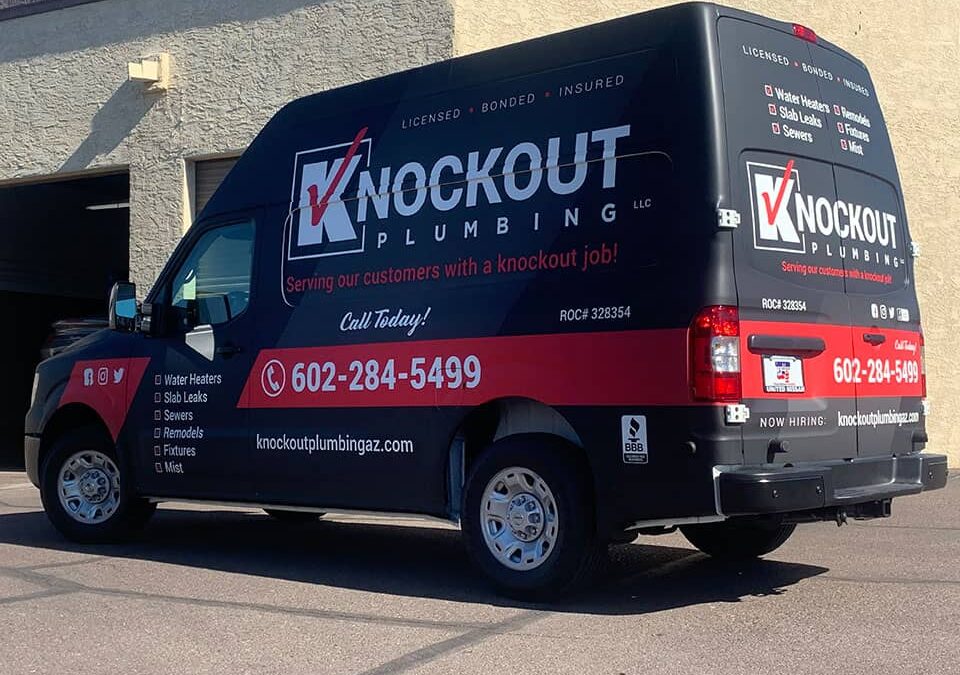
A shared design can be laid out for each vehicle model so the branding reads the same across the fleet. Our process runs from consultation and measurement to design and a proof for your approval, then printing and installation in-house, on a schedule that fits your operation. Design time depends on your artwork (vector logo files are a head start; with none, our designers can build it, logo included), how many body styles you run and changes after the proof.
Installing Around a Working Fleet: Scheduling and Phased Installs
Installation happens at our Tempe shop, so each vehicle is off the road for a time that depends on its size, coverage and condition. Tell us how many vehicles can be down at once and who will bring each one in; for larger fleets, ask about phased scheduling that keeps your operation moving. Prep takes time, too: 3M excludes failures from improper surface preparation, and Avery’s MPI 1105 data sheet doesn’t warrant removability from pre-existing graphics, including “damage to existing graphic when film is removed,” so plan on old lettering or an old wrap coming off first.
The Vehicles Themselves: Paint Condition Now, Removal Later
Paint condition
The makers’ terms assume sound factory paint. 3M’s 2080 bulletin names “standard OEM vehicle paint” as the intended substrate, and its warranty bulletin lists “a repaired surface,” surfaces “exhibiting oxidation or chalking” and “body damage on vehicles” among substrates “NOT considered suitable.” Avery lists “Non-OEM painted vehicles” as an unsuitable use for SW900 and MPI 1105. Faded or peeling paint, rust, dents or a repaint may need repair first or fall outside the makers’ terms, which is why photos belong in a quote request.
Removal at the end of a lease
Removal is labor, and the makers back it only within limits: 3M’s 2080 bulletin describes the film as removable with heat and/or chemicals from most surfaces within the warranty period and makes no claims about the speed of removal, and 3M’s Graphics Products Warranty Bulletin says 3M does not warrant the ease or speed of removal. Avery’s MPI 1105 data sheet sets the removal period “within the warranted life of the graphic” and doesn’t warrant removal from “automotive paint that is greater than 5 years old.” 3M’s 2080 card excludes “paint pull during film removal process.” Zone 3’s reduced terms shorten that period, so plan each leased vehicle’s removal well before turn-in.
What We Need From You to Quote a Fleet
Send these with your quote request:
- Vehicle list: year, make, model and body for each, and how many of each.
- Coverage: lettering to full wrap for each vehicle, roofs in or out.
- Artwork: vector logo files and brand colors, or none yet.
- Photos: every side, plus close-ups of dents, rust, faded paint, repairs and existing graphics.
- Timing: your deadline, and how many vehicles can be off the road at once.
- Owned or leased: plus turn-in dates.
For questions to ask any shop, see how to choose a vehicle wrap shop in Phoenix.
Frequently Asked Questions
How much does a fleet wrap cost in Phoenix?
It depends on the vehicles, the coverage on each, the film and overlaminate, the design work, the installation schedule and the paint underneath. Send your vehicle list and photos for a free quote, or start with our fleet wraps page.
How does wrapping several vehicles at once affect the quote?
A shared design can reduce duplicated design work, and a full vehicle list lets installs be scheduled together. The number for each vehicle still depends on the quote: the vehicle mix, the coverage, each vehicle’s condition and the schedule.
Should we wrap the roofs of our vans and box trucks?
That’s your call. A roof may get less street-level visibility than the vehicle sides, and horizontal surfaces get the least coverage; Avery’s bulletin leaves them unwarranted unless a film’s data sheet says otherwise. Ask for the terms for the sides and for hoods and roofs before you decide.
How long will a fleet wrap last in the Phoenix sun?
There’s no single number. For a printed fleet wrap, the benchmark is the maker’s published term for the exact film, overlaminate, ink and printer on your quote; in Arizona’s Zone 3 those terms are reduced and lowest on hoods and roofs. Care counts, too: 3M excludes abrasion damage from brushes and pressure washing.
Can leased vehicles be wrapped and returned?
Yes, if the lease allows graphics; plan the removal from the start. Both makers describe removability within the warranty period, which is shorter in Zone 3, and neither warrants the ease or speed of removal. For short terms, 3M’s IJ180 product bulletin lists an ultra-removable print film, IJ180mC-10UR, as a “shorter term option.”
Ready to Price Your Fleet?
Fleet wrap cost in Phoenix comes down to your vehicles, so a real number starts with your list. ProVinyl Solutions has designed, printed and installed vehicle wraps in Tempe since 2014 for businesses across Phoenix, Tempe, Scottsdale, Mesa, Chandler, Gilbert, Glendale and Queen Creek. For a free consultation and quote, call (480) 410-9727 or contact us here.
Recent Comments